August 11, 2026
Professional Stamped Component Supplier for Laptops, Home Appliances and Medical Devices
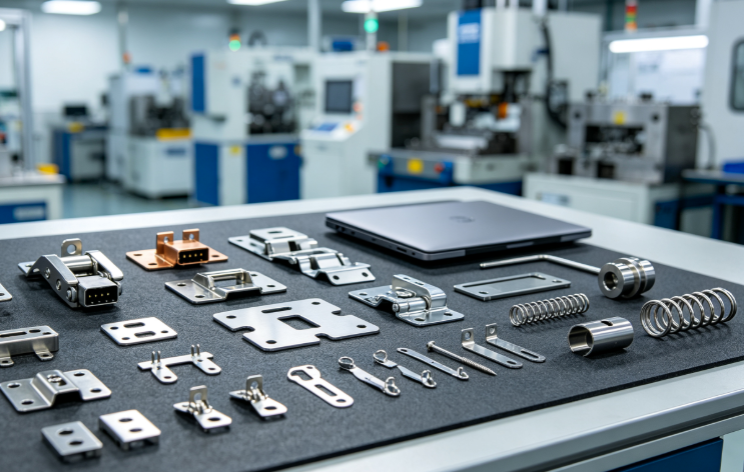
Table of Contents
Introduction: The Hidden Backbone of Modern Devices
What Defines a Professional Stamped Component Supplier
Precision Stamping for Laptops: Where Every Micron Counts
Home Appliances: Reliability at Scale
Medical Devices: Cleanroom-Ready and Regulation-Compliant
The Competitive Advantage of Vertically Integrated Suppliers
FAQ
1. Introduction: The Hidden Backbone of Modern Devices
From the moment you open a laptop, adjust a thermostat, or rely on a medical device for a diagnosis, you are interacting with precision stamped metal components. These parts—connectors, terminals, shielding covers, springs, and hinges—are rarely visible, yet they are essential to the device's performance, durability, and reliability.
The devices shaping our lives today demand increasingly higher precision from stamped components. Laptop hinges must survive thousands of open-close cycles without loosening. Medical device components must resist corrosion and meet biocompatibility standards. Home appliances require stamped parts that maintain consistent performance across millions of production units.
Selecting the right stamped component supplier is not just a procurement decision—it is a strategic choice that determines product quality, time-to-market, and regulatory compliance. This guide examines what defines a professional supplier and what makes them capable of serving these demanding industries.
2. What Defines a Professional Stamped Component Supplier
A professional stamped component supplier is distinguished by more than equipment. Key indicators include:
In-House Tooling and Die Design
Suppliers who design and manufacture their own tooling offer faster response times and tighter quality control. Precision Stamping Parts, for instance, maintains a dedicated tooling department with 53 professional and technical personnel, including 8 senior engineers with over 15 years of design experience . This allows them to complete both mold design and stamping in-house, quickly responding to customer needs.
Material Expertise
Professional suppliers work across a wide range of materials: stainless steel (grades 301, 304, 316, 430), copper alloys, aluminum, and specialized alloys. FRIMA, for example, offers material thicknesses from 0.1mm to 3.0mm, with tolerances as tight as ±0.01mm .
Quality Management Systems
Top-tier suppliers maintain certifications including ISO 9001, ISO 14001, and for medical applications, ISO 13485 . These certifications are not just paperwork—they represent validated processes, full material traceability, and rigorous dimensional inspection protocols.
Production Capability
Capability | What It Means |
High-speed progressive stamping | High-volume runs with consistent precision |
Deep drawing | Complex parts with depth and uniform strength |
Compound and transfer dies | Multi-operation parts in a single press |
Secondary operations | Machining, deburring, plating, assembly |
3. Precision Stamping for Laptops: Where Every Micron Counts
Laptop manufacturers demand stamped components that fit within increasingly tight mechanical envelopes while withstanding constant use. The stakes are high: a poorly designed hinge or imprecise connector can affect user experience and trigger costly warranty returns.
Key Components for Laptops
Laptop manufacturers require a variety of stamped components :
·
Hinges (Hinge/Rotating Shafts): The notebook hinge is a highly sophisticated mechanical system that requires precise stamped and machined components. Suppliers like XINLIAN GANG Electronics supply to major brands including HP, Asus, and Dell, shipping over 15 million hinge units annually .
·
·
Connectors and terminals: Motherboard connectors, USB ports, and power interface components require precision stamping with tight dimensional control.
·
·
Shielding components (EMI/RFI shields): These stamped covers protect sensitive electronics from electromagnetic interference.
·
·
Support brackets and battery contacts: Camera brackets, power supports, and battery shrapnel components that must maintain contact pressure over long device life.
·
Precision Requirements
Leading suppliers for the laptop industry operate at tolerances of ±0.01mm or tighter . Some suppliers have developed specialized capabilities for ultra-thin laptops, becoming the processing benchmark for shaped balance bars in the industry . Their products are used in devices from global brands including Apple, Amazon, DJI, Anker, and Honor .
4. Home Appliances: Reliability at Scale
Home appliance applications demand stamped parts that combine durability with cost-effectiveness. Refrigerators, washing machines, microwave ovens, and air conditioners rely on precision-stamped components that must withstand years of daily use without degradation.
Common Stamped Components in Appliances
·
Internal frames and brackets: Provide structural support within the appliance
·
·
Thermostat and control springs: Ensure precise temperature regulation
·
·
Refrigeration system components: Critical for sealing and heat exchange
·
·
Door hinges and latch assemblies: Engineered for high-cycle wear resistance
·
The Scale Challenge
Appliance OEMs typically require stamped components in high volume, often across multiple production runs spanning years. Suppliers must maintain consistent quality across production cycles while achieving competitive unit pricing. The highest-tier suppliers achieve the same process capability for appliance components as they do for medical parts, with CPK ≥ 1.67 for critical dimensions .
5. Medical Devices: Cleanroom-Ready and Regulation-Compliant
Medical device applications impose the highest standards on stamped component suppliers. Components must be biocompatible, corrosion-resistant, and manufactured with absolute consistency over thousands of cycles . Errors are not acceptable—a faulty component can impact patient safety and trigger regulatory action.
Medical Applications for Stamped Components
Industry data shows medical stamped components are used in :
·
Surgical instruments: Springs and wire forms for endoscopic tools, staplers, and robotic surgery components
·
·
Drug delivery systems: Inhalers, auto-injectors, and insulin pens
·
·
Diagnostic equipment: Precision contacts and clips for blood analyzers, imaging systems, and laboratory automation
·
·
Orthopedic devices: Components made from implant-grade alloys like 316L and Elgiloy
·
Cleanroom and Regulatory Requirements
Medical-grade stamping suppliers must maintain ISO Class 7 or Class 8 cleanroom environments and full ISO 13485 certification . They must provide full material certifications and rigorous dimensional inspection reports with every batch.
FILAME, for example, specializes in precision springs and stamped parts using advanced materials like 316L stainless steel and Elgiloy, with automated optical measurement systems verifying every part . NN Inc. manufactures syringe safety clips and metering springs for asthma inhalers, maintaining the highest quality standards .
6. The Competitive Advantage of Vertically Integrated Suppliers
The most capable stamped component suppliers share a common characteristic: vertical integration. By controlling the entire production chain from tool design through finishing, they reduce lead times, maintain quality consistency, and respond faster to customer needs.
Key Dimensions of Vertical Integration:
Capability | Benefit |
In-house tool design and manufacturing | Shorter development cycles, lower tooling costs, faster iteration |
Multiple stamping processes | One supplier for diverse component needs (progressive, deep draw, fourslide) |
In-house secondary operations | Welding, riveting, plating, assembly under one roof |
Cleanroom and validation services | Ready for medical-grade production without subcontracting |
Full documentation | Material certifications, inspection reports, PPAP packages |
Vertical integration also enables early collaboration on design optimization. Suppliers with in-house engineering teams can provide Design for Manufacturing (DFM) feedback during product development, identifying potential issues before tooling begins and helping customers avoid costly design changes later.
For example, suppliers with over 30 years of stamping experience and large engineering teams can rapidly build R&D samples and recommend design improvements when prototypes reveal capability limitations . This shortens the product development cycle and reduces risk.
7. FAQ
Q: What industries require the highest precision from stamped components?
A: Medical device manufacturing and laptop/consumer electronics typically require the tightest tolerances (±0.01mm or better), followed by automotive and aerospace applications. Medical components also require biocompatibility, cleanroom production, and full traceability.
Q: What tolerances can a professional stamping supplier achieve?
A: Leading suppliers achieve tolerances of ±0.01mm for precision parts, with some ultra-precision applications reaching ±0.005mm . The achievable tolerance depends on material thickness, part geometry, and production volume.
Q: What certifications should a supplier for medical devices hold?
A: ISO 13485 is the primary certification for medical device manufacturing. Cleanroom production (ISO Class 7 or 8) is typically required. Full material certifications and dimensional inspection reports should accompany every shipment.
Q: What is the typical lead time for a custom stamped component?
A: Tooling development typically takes 7–15 days, with mass production lead times ranging from 7–20 days depending on order quantity . Complex parts or multi-cavity tools may require longer development cycles.
Q: How do I choose between a standard stamping supplier and a specialist?
A: If your application requires cleanroom production, tight tolerances (±0.01mm or better), or validation documentation, choose a specialist with relevant certifications and experience. For general industrial applications, a standard supplier may be sufficient.